Brand-Led Home Experience
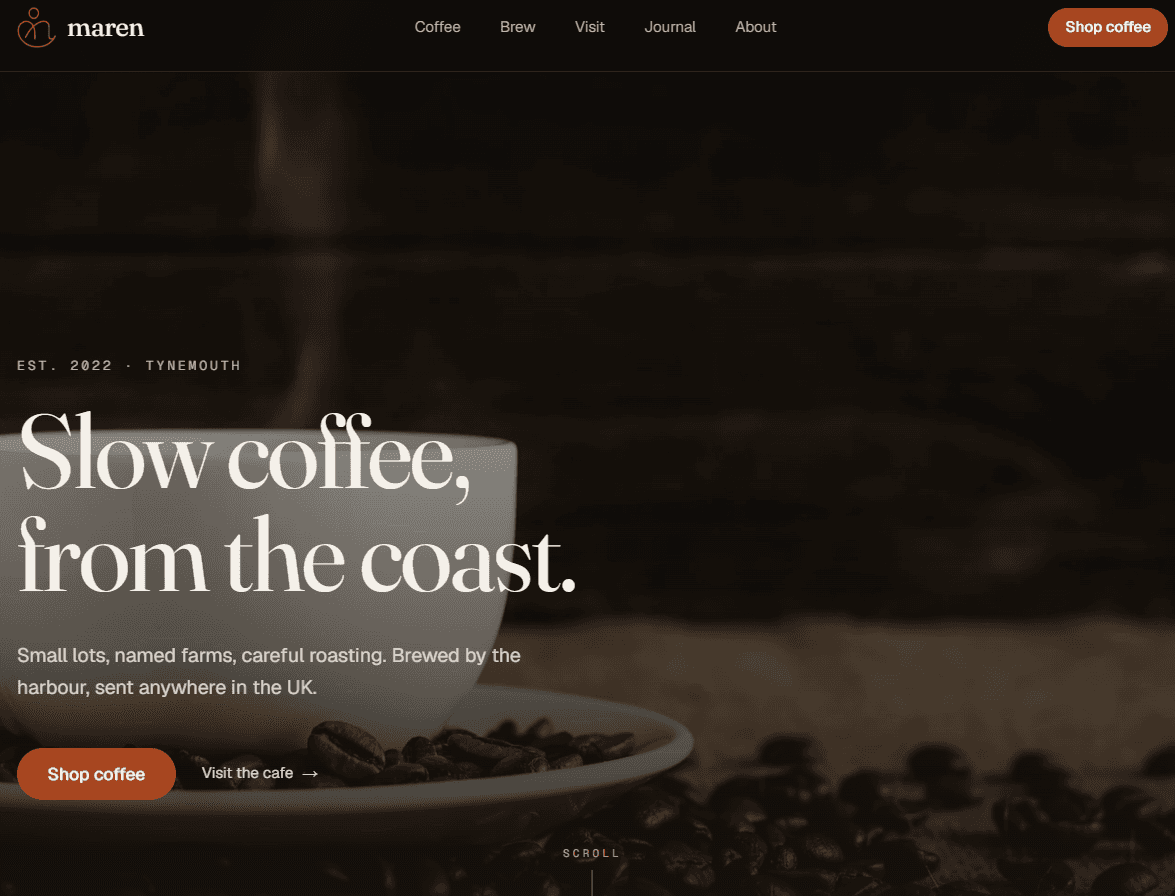
- Editorial hero with atmospheric visual direction
- Structured section flow for narrative pacing
- Motion accents designed to support hierarchy, not distract
Portfolio Case Study
Maren is a premium coffee brand concept translated into a deployable, editorial website with clear UX structure and production-ready frontend execution.
Product focus
Brand-led small-business website for discovery, trust, and enquiry conversion.
Architecture
Next.js App Router with typed content modules, reusable UI components, and static route generation.
Build priority
Editorial look and feel without sacrificing usability, accessibility, and performance.
Maren was built as a flagship freelance portfolio piece to simulate a premium client delivery from strategy through launch.
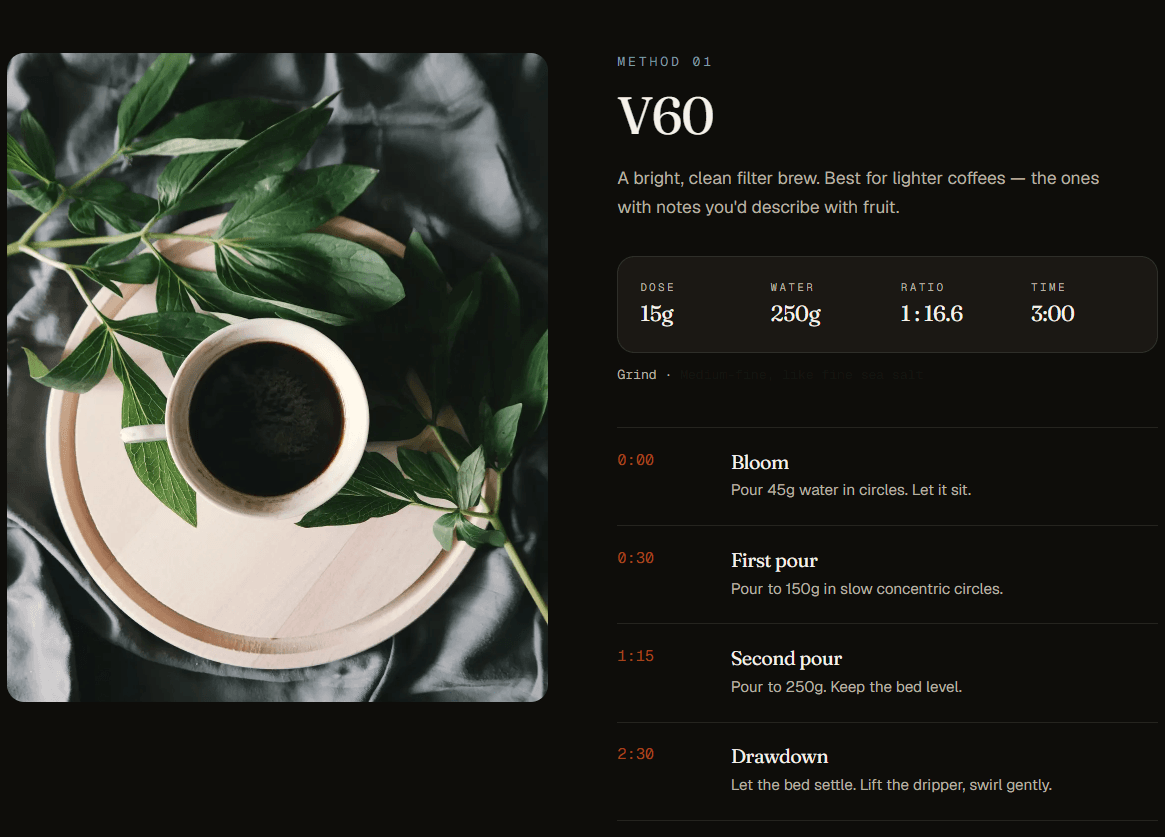
The site is structured around real user goals: understand the brand, browse coffees, learn brew methods, plan a visit, read journal content, and send an enquiry.
Every route and component was designed to feel cohesive while still supporting different content types, from story-led sections to practical information cards and forms.
Many portfolio projects look good in a single hero screenshot but break down when evaluated as complete products.
Maren solves that by demonstrating a full, coherent website system: brand voice, information architecture, design consistency, frontend quality, and deployable engineering choices.
Maren was built around a small set of explicit principles.
Maren is a Next.js 16 App Router project with React 19 and TypeScript, structured around route-level server rendering and targeted client islands for motion and interactivity.
Content is modeled in typed TypeScript modules and consumed by route components, allowing predictable data flow and low-friction updates without a CMS.
Styling is handled with Tailwind v4 and tokenized design values, enabling a coherent visual language across all page types.
The project uses typed local content modules to keep iteration speed high and reduce integration overhead while still modeling real-world data relationships.
Most pages are server-rendered by default, with client-side code introduced only where interaction or animation requires it.
Shared containers, sections, media wrappers, and utility components reduce duplication and enforce consistency across routes.
Motion patterns are centralized and designed to honor reduced-motion preferences, preserving structure without forcing animation.
I delivered Maren end-to-end: concept, brand direction, IA, UX patterns, visual system, component architecture, typed content modeling, implementation, and deployment-ready setup.
The project demonstrates ownership across strategic framing, design execution, and frontend engineering quality.
The interface needed to feel distinctive and premium without reducing scanability, contrast, or conversion clarity.
Home storytelling, catalogue browsing, long-form journal reading, and utility pages required different layouts while still feeling like one system.
Animation was scoped to high-value interactions and section reveals so the site retained atmosphere without becoming heavy.
Quality effort focused on maintainability, predictable rendering, and interaction clarity.
Maren is structured for straightforward deployment as a static-first Next.js site with modern frontend tooling and repository-based workflows.